

Davis OT Blog
ADHD Coaching

What’s the Difference Between Working With a Coach and Working With an Occupational Therapist?
ADHD coaching can be a valuable support for adults, teens, and families who are trying to improve organization, follow-through, time management, emotional regulation, routines, and daily functioning. However, the term “ADHD coach” can mean many different things. Some coaches have extensive ADHD-specific training and strong ethical frameworks, while others may have limited formal education or no regulated oversight.
When choosing support, it is helpful to understand the difference between ADHD coaching provided by a non-regulated professional and ADHD-focused intervention provided by a regulated health professional, such as an occupational therapist.
What ADHD Coaching Often Focuses On
ADHD coaching typically supports practical skill-building in daily life. This may include:
Time management and planning
Task initiation and follow-through
Reducing overwhelm
Prioritizing tasks
Building routines
Improving accountability
Understanding ADHD-related patterns
Developing strategies for school, work, home, or relationships
A well-trained ADHD coach may be very skilled at helping clients identify barriers, set realistic goals, and develop external systems that support executive functioning.
What Makes Occupational Therapy Different?
Occupational therapists are regulated health professionals. This means they are accountable to a professional college, must meet defined practice standards, and are required to practise within an ethical and evidence-informed framework.
An OT can support many of the same executive functioning goals as an ADHD coach, but the clinical lens is broader. OTs assess how ADHD impacts participation in everyday activities, including work, school, self-care, home management, parenting, sleep, sensory regulation, emotional regulation, and community participation.
Rather than focusing only on productivity or habits, an OT considers the whole person, the environment, the task demands, and the client’s health history.
Key Differences to Consider
1. Regulation and Accountability
A regulated health professional is accountable to a professional regulatory body. This offers clients a formal process for concerns or complaints, as well as minimum expectations for consent, confidentiality, documentation, professional boundaries, and competence.
ADHD coaching, as a standalone service, is not consistently regulated. This does not mean coaching is unsafe or ineffective, but it does mean clients need to ask more questions about training, scope, supervision, and accountability.
2. Clinical Assessment
An occupational therapist can complete a clinical assessment of how ADHD affects daily functioning. This may include executive functioning, sensory processing, fatigue, sleep, burnout, mental health factors, environmental demands, and functional barriers.
A coach may focus more specifically on goals, habits, planning, motivation, and accountability. This can be very useful, but it may not include the same level of clinical reasoning or assessment.
3. Scope of Practice
An ADHD coach may help with strategies and accountability, but should not be diagnosing, treating mental health conditions, providing psychotherapy unless separately qualified, or making clinical recommendations outside their training.
An OT can provide intervention related to function, participation, regulation, environmental modification, workplace accommodations, school strategies, and disability-related needs. OTs also understand when concerns fall outside their scope and when referral to a physician, psychologist, psychotherapist, or other provider is needed.
4. Complexity of Needs
ADHD coaching may be a good fit for someone who primarily wants help with planning, productivity, routines, or accountability.
OT may be a better fit when ADHD overlaps with burnout, anxiety, depression, autism, sensory sensitivity, chronic fatigue, pain, sleep disruption, workplace disability, school participation issues, or difficulty managing daily life demands.
5. Documentation and Accommodation Support
For clients seeking workplace or school accommodations, a regulated health professional may be better positioned to provide functional documentation, recommendations, and rationale. OTs are trained to assess task demands, environmental barriers, functional abilities, and participation restrictions.
A coach may provide helpful observations or strategy support but may not be accepted as a health professional for formal accommodation or disability-related documentation.
Questions to Ask Before Starting
Before choosing a provider, consider asking:
What is your ADHD-specific training?
Are you regulated by a professional college or governing body?
What is your scope of practice?
How do you handle confidentiality and consent?
Do you provide clinical assessment or coaching only?
Do you have experience with clients who have ADHD and anxiety, depression, autism, burnout, or sensory sensitivities?
Can you provide documentation for school, work, or insurance purposes?
How do you measure progress?
What happens if my needs are outside your scope?
Do you offer practical strategies that fit real life, not just productivity expectations?
When Coaching May Be Enough
ADHD coaching may be appropriate when the person is generally stable and looking for structured support with organization, planning, time management, routines, accountability, or goal follow-through.
When OT May Be a Better Fit
Occupational therapy may be more appropriate when ADHD is affecting multiple areas of life, when there are co-occurring health concerns, when sensory or emotional regulation is a major barrier, when burnout is present, or when functional documentation is needed for workplace or school accommodations.
The Bottom Line
ADHD support is not one-size-fits-all. A skilled ADHD coach can be an excellent support for practical executive functioning strategies. A regulated health professional, such as an occupational therapist, brings an added layer of clinical assessment, accountability, and whole-person functional reasoning.
The best choice depends on the person’s needs, the complexity of their situation, and the type of support they are looking for.
If you’re unsure whether ADHD coaching or occupational therapy is the right fit, we can help you determine the level of support that matches your needs.

Understanding Financial Supports for Medical Leave in Ontario
Explore EI sickness, disability benefits, and paid leave options in Ontario. Learn how to manage burnout and protect your income.
Burnout doesn’t happen overnight. It builds gradually through sustained stress, cognitive overload, and a mismatch between demands and capacity.
For many of the individuals we support at Davis Occupational Therapy, the turning point comes when continuing to work is no longer sustainable.
If you’re at that point, one of the biggest questions becomes:
“How will I manage financially if I need to step away from work?”
The good news is there are several financial supports available to Ontario residents. The challenge is understanding how they work, and in what order to access them.
What Burnout Really Looks Like

Before we dive into financial supports, it’s important to understand what burnout can look like.
Common signs include:
Persistent mental and physical exhaustion
Reduced concentration and productivity
Increased errors or difficulty completing routine tasks
Emotional detachment or irritability
Loss of motivation or sense of accomplishment
Sleep disruption and ongoing fatigue
Burnout is not just “feeling stressed”, it is a clinically recognized occupational phenomenon that can significantly impact function.
If you’re unsure speak to your Family Doctor and schedule a visit with an OT.
Financial Supports Available During a Medical LOA

Paid Sick Time
This is typically your first line of support.
Some employers offer paid sick days or salary continuance
In Ontario, the minimum standard is 3 unpaid sick days per year under the ESA
Many workplaces offer more generous plans through benefits
Clinical Note: Paid sick time is ideal for short-term recovery or bridging into other benefits.
2. Short-Term Disability (STD)
If your workplace offers benefits, Short-Term Disability is usually the next step.
Provides income replacement (typically 60–100% of salary)
Covers approximately 15–26 weeks in most plans
Requires medical documentation (often from your physician and/or OT)
Clinical Note: When on STD, seek out an OT to assist with recovery and planning a gradual return to work.
3. Employment Insurance (EI) Sickness Benefits
If you don’t have STD, or once it ends, you may qualify for EI Sickness Benefits.
Up to 26 weeks of financial support
Pays approximately 55% of your income (up to ~$729/week)
Requires a medical certificate confirming inability to work
Must apply promptly after stopping work to avoid losing benefits
Important: You cannot receive EI sickness benefits at the same time as STD.
4. Long-Term Disability (LTD)
If your condition persists beyond the short-term window, LTD may be available.
Typically begins after STD or EI ends
Provides ongoing income replacement (often ~60–70% of salary)
Eligibility criteria are more stringent and often reassessed
Clinical Reality: Many burnout cases that are not addressed early can progress into LTD claims.
5. Additional Supports
Depending on your situation, you may also be eligible for:
Canada Pension Plan (CPP) Disability – for severe and prolonged conditions
Ontario Disability Support Program (ODSP) – income and health supports (e.g., up to ~$1,400/month for basic needs)
Workplace accommodations – to prevent or delay a full leave
Private disability insurance – if you hold an individual policy
What Not to Do When Burnout Hits

One of the most common (and problematic) patterns we see is:
“I’ll just take a week off and push through.”
Vacation time is not designed to treat burnout.
It does not provide structured recovery
It delays appropriate medical support
It can worsen long-term outcomes
It often leads to a cycle of repeated short absences
Bottom Line: If you require time off for medical reasons, it should be supported as a medical leave, not masked as vacation.
How These Benefits Work Together
For many individuals, the progression looks like this:
Paid sick days
Short-Term Disability (if available)
EI Sickness Benefits (if needed)
Long-Term Disability (if recovery is prolonged)
Understanding this sequence can reduce uncertainty and help you plan proactively.
How Occupational Therapy Can Help
At Davis Occupational Therapy, we support individuals navigating:
Burnout and cognitive overload
Medical leave planning and documentation
Functional assessments for disability claims
Gradual return-to-work planning
Workplace accommodation recommendations
Our approach is practical, structured, and focused on restoring function, not just managing symptoms.
Ready to Explore Your Options?
If burnout is on your mind and you’re unsure what your next step should be…
👉 Book a Discovery Call with one of our Adult OTs
Let’s create a plan that supports both your health and your financial stability.

5 Tips for Deciding Whether to Disclose Your ADHD Diagnosis at Work

Adult sitting in an open office environment, contemplating the information on his computer screen.
Start with what you need to do your job well
Disclosure doesn’t have to focus on your diagnosis. Instead, think about the specific supports that would help you perform at your best—such as flexible scheduling, clearer task prioritization, written instructions, or reduced interruptions. An OT can help you advocate, articulate and develop individualized supports.In Ontario, employees generally have the right to keep their personal health information private. Employers may only request information reasonably necessary for tasks like workplace accommodation. When disclosed for such purposes, this information must be handled with strict confidentiality, shared only with authorized personnel, and kept separate from general personnel files.
Highlight your strengths and strategies
When discussing workplace needs, it can be helpful to share how you already manage your work successfully. For example, you might describe strategies that have worked well in the past in different work environments or accommodations that have helped you stay organized and productive. This shows initiative and emphasizes the value you bring to the team. Your OT can explore the past with you in an effort to build on what has previously worked.
Understand the accommodation process
If you request formal accommodations, your employer may ask for documentation outlining your functional abilities and limitations. In many workplaces, this process goes through Human Resources and focuses on how to support your work performance rather than on diagnostic details. Your OT can connect with HR on your behalf to determine the process for presenting accommodations. Many accommodations can be self-managed and need not be disclosed to your employer.
Focus on collaboration, not a single solution
Accommodation discussions are typically a collaborative process. Be open to exploring different options with your manager or HR that meet both your needs and the organization’s workflow. Often there are multiple ways to create a supportive work environment. Your OT will ‘propose’ accommodations to be considered.
Remember that disclosure is a personal decision
There is no universal “right” time or reason to disclose. Some people choose to share their diagnosis to access accommodations, while others prefer to request adjustments without disclosing specific medical information. Taking time to consider your workplace culture, your needs, and your comfort level can help you decide what feels right for you.
Want to explore disclosure and accommodations further?
Reach out to one of our Adult OTs to book a discovery call.

Why do so many people with ADHD struggle with Time Management?
The struggle is real with Time Management amongst adults with ADHD, and honestly many others with lots of things on their plate. Read on to understand why this occurs and learn some ways to try to improve in your ability to be on time!
Have you ever lost track of time? Have you struggled to finish tasks by the deadline? For many people with ADHD, this is a common experience. ADHD can impact how the brain manages time, attention, and organization. This blog post explores why time management is challenging for individuals with ADHD and offers helpful strategies.
Hyperfocus
When people with ADHD engage in a task that interests them, they can become very concentrated and lose track of time (Tate, 2025). This tunnel vision can cause them to miss deadlines and neglect their personal life (Middleton, 2025). While hyperfocus can result in high-quality work, everything else often falls by the wayside (Tate, 2025).
Hyperactivity & Impulsivity
People with ADHD can have trouble sitting still while focusing on a task (Middleton, 2025). When you are hyperactive, you may have excessive movement that you need to let out. You may also feel impulsive. This means you can act hastily without considering your initial plan (Levrini, 2023).
Distractions & Time Blindness
Individuals with ADHD can have difficulty estimating how long tasks will take. It often can feel like time slips away unnoticed. Time blindness can often happen when there are distracting internal and external stimuli. You may find yourself thinking about everything else but what’s right in front of you (Middleton, 2025).
Working Memory, Planning & Prioritization
Individuals can have trouble organizing and sequencing tasks. They may focus on more preferred tasks and procrastinate on non-preferred tasks. This can lead to missed deadlines and last-minute rushes (Tate, 2025). These difficulties are often linked to challenges with working memory. This is the brain’s ability to hold and quickly access short-term information. Poor working memory makes it harder to keep track of steps and priorities (Tate, 2025).

Tips to Help with Time Management
Identify your distraction triggers
External: Auditory (conversations, phone notifications, email alerts) or visual (people walking by, cluttered desks).
Internal: Racing thoughts, boredom, emotional states, physical sensations (Tate, 2025).
2. Minimize distractions
Optimize your work location. Choose a desk that minimizes visual and auditory distractions.
Reduce visual clutter on your desk.
Turn off non-essential notifications on your phone or inbox.
Set boundaries with others.
3. Manage wandering thoughts
Keep a notepad nearby. When an unrelated thought or worry pops into your head, jot it down on a notepad. This acknowledges the thought without derailing your current task.
Mindful awareness: When your mind wanders, gently redirect your attention.
Pre-task brain dump: Before focusing on a task, spend 5 minutes writing down lingering thoughts or concerns. Get them out on paper to clear your mind.
4. Keep track of your schedule
Visual timers can show how much time is passing.
Visual checklists: Check off what you have completed. This provides you with positive feedback and clarifies what remains.
Mind Maps can help organize complex information. It can be easier to process than regular note-taking.
Setting goals: Individuals can use the image of their goal to guide and direct their actions. Your goals should be SMART: Specific, Measurable, Achievable, Realistic and Time-bound.
5. Ask for accommodations (if applicable)
Environmental modifications: quieter workplace location, light adjustments (natural light, reduced fluorescent exposure)
Time management supports: modified work schedules, extended deadlines, regular check-ins with someone, etc.
Communication adjustments: written follow-up after verbal instructions (Tate, 2025).
Building time management skills takes practice. With some self-compassion and the right tools and strategies, it is possible! Be patient with yourself and advocate for the accommodations you need.
Still feeling a little lost? Perhaps having an Occupational Therapist customize these strategies for your specific needs will help. Reach out to Kayla or Emily today to see if OT can help you get a better sense of time.

How Art Supports Neurodiverse Minds
Learn about how art therapy can support adults and teens with autism spectrum disorder, ADHD, and mental health challenges. Consider joining our art-based OT group at Davis OT!
How We Define the Arts at Davis OT
At Davis OT, we view the arts as a meaningful way to engage in creative expression through activities like drawing and painting. The goal is not to produce the ‘perfect’ art piece. Instead, we use art as a tool to support creative expression, sensory regulation, social connection, and self-esteem. In an occupational therapy program, art can help improve mental health. It also offers a safe space for sharing stories.
3 Ways Art-Based OT Groups Can Help You!
1. Improves health & wellness
Research indicates that leisure can help the general adult population gain spiritual well-being. The adolescent population is similar. Teens involved in leisure activities have better mental health and a higher quality of life (Stacey et al., 2018).
2. Strengthens social connections
Studies suggest that being part of a group sharing a common interest can help cultivate a sense of belonging (Stacey et al., 2018). Additionally, interacting with others while doing arts can help reduce loneliness and isolation. Studies indicate a link between loneliness and mental illness (Fancourt & Finn, 2019).
3. Supports health education
Through discussions with their peers, participants can:
Learn how to manage health conditions.
Help build trust around sensitive health topics.
Raise awareness of communicable diseases and broader health issues.
Improve medication and treatment adherence through storytelling (Fancourt & Finn, 2019).

Art and Autism
1. Powerful communication tool
Art is not just a way to create. It is also a powerful tool for communication, especially for those in the autistic community. Research shows that art groups can improve social skills and language (Fancourt & Finn, 2019). Autistic individuals often find it hard to share their thoughts and feelings. Thus, art can help others understand their experiences (Stacey et al., 2018).
2. Lowers stress
Evidence also shows that art can lower stress, lift mood, and build self-esteem in autistic individuals (Fancourt & Finn, 2019).
3. Builds emotional awareness
Through art, autistic individuals can begin to:
Recognize their emotions.
Understand and process how these emotions show up in their bodies.
Develop strategies for self-regulation.
Art and the ADHDer
For individuals with ADHD, art provides an opportunity to express, regulate, and reflect on emotions. Safran (2012) shows that art activities can help people with ADHD feel better.
Like those on the autism spectrum, art helps people with ADHD share strong feelings that words cannot express. Drawings also help art group participants learn how ADHD affects emotions (Safran, 2012).
Art therapy can enhance self-regulation in individuals with ADHD. For example, art supports self-regulation for those with ADHD by offering:
A safe space to channel their hyperactive or impulsive energy.
An alternative to suppressing their behaviours.
A way to return to a calm, focused state (Safran, 2012).
Finally, art can be a tool to record what individuals feel in the moment. This can be useful, as the individual can go back to the artwork later to reflect and understand what they felt.

The Role of Art in Mental Health and Wellbeing
Throughout history, people have engaged in painting, storytelling, and dancing to heal themselves. Psychologists now see that art therapy can heal emotional traumas. It helps raise awareness of feelings within oneself and others. Additionally, it can change unhelpful thought patterns (Shukla et al., 2022). Furthermore, art therapy can reduce depression and anxiety symptoms.
Join Our Art-Based OT Group!
Davis Occupational Therapy is excited to offer a new Art-Based OT group. This pilot group will take place on May 3rd at 12pm, at Beetle & Bear Clinic. This group welcomes neurodiverse young adults and teens and aims to promote self-expression, socialization, and emotional regulation. No art experience is required. Click the link below to learn more about this exciting new group.
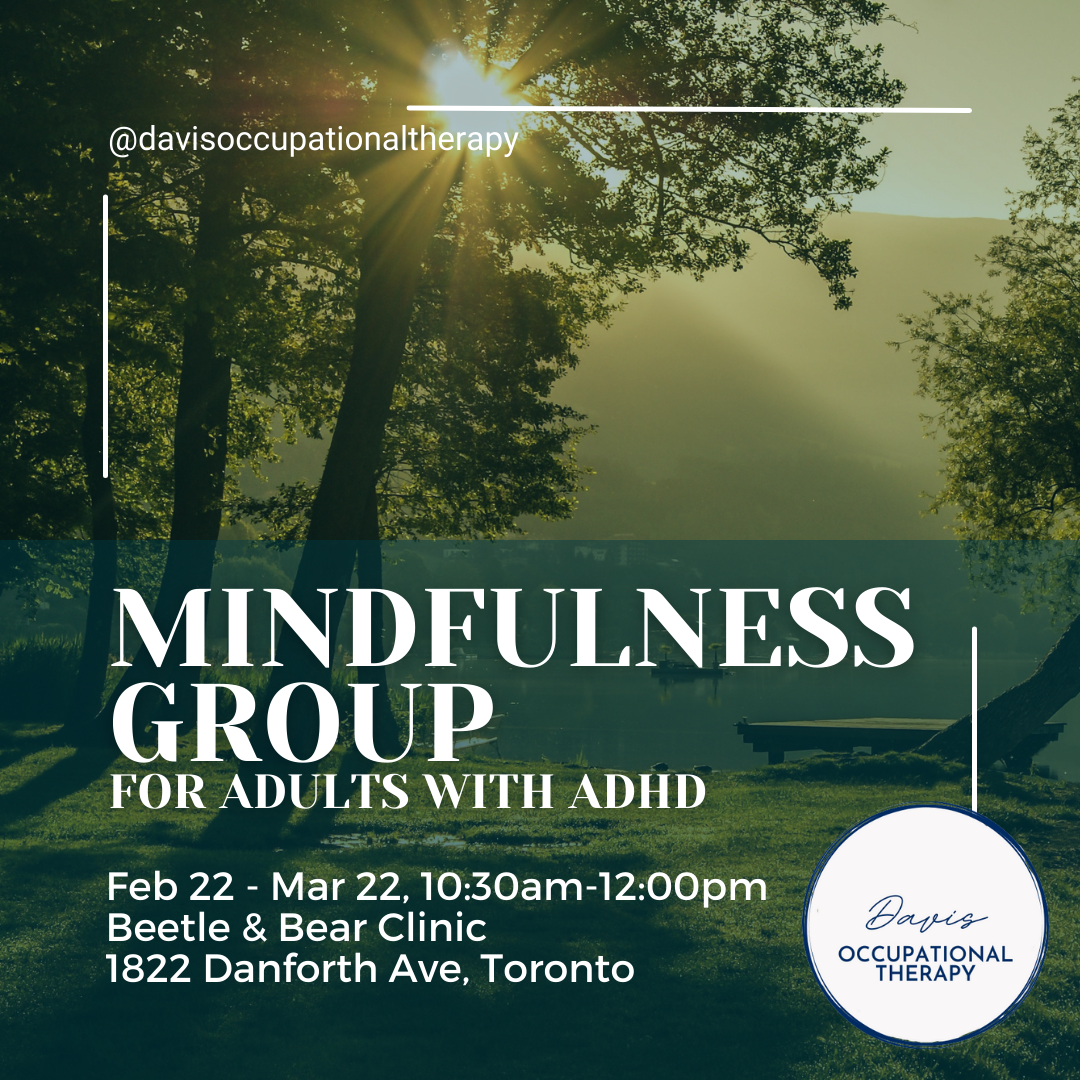
More than Meditation: Mindfulness as a Tool for Adults with ADHD to Live Intentional, Fulfilling Lives
Join, guest blogger - OT Emily as she explains the benefits of mindfulness for adults with ADHD. Consider joining our Mindfulness Group for Adults with ADHD.

Whether you were diagnosed in childhood or self-diagnosed more recently, as an adult with ADHD, you are likely familiar with the apps, lengthy books, social media accounts, life hacks, and well meaning advice from friends/family/coworkers on how to organize your house, stay on task, quit procrastinating, stop scrolling, maintain a schedule… and the list goes on.
While these resources may be helpful, more often than not, they can add to the already long list of overwhelming mental demands that leave you feeling stuck and disappointed. I want to emphasize that it is not a personal failure if you have not used that new organizational app, finished that self-help book, or replicated the schedule of your co-worker who seems to have it all together. At the core of an ADHD diagnosis lies difficulty with (A) attention and (B) executive functioning (i.e. cognitive functions like planning, organizing, problem solving, memory, and self-control) (APA, 2013). Both these cognitive domains (attention and executive function) are needed to implement strategies and reach our goals. A more helpful approach would therefore address difficulties with attentional regulation and executive functioning, thereby enabling you to change the way you function and feel.
And for this the research points to Mindfulness!
Evidence-based research suggests, mindfulness interventions may be particularly helpful in regulating attentional processes and executive functions, two core symptom clusters of ADHD (Bachmann et al., 2017; Poissant et al., 2020).
And no, you do not need to meditate to practice mindfulness!
Keep reading to learn what mindfulness is and is not and how it may help you navigate daily challenges, live intentionally, and thrive.
What is mindfulness?
Mindfulness is the practice of being attentive to and accepting of experiences in the present moment. Traditionally, we may think of mindfulness as silent meditation; however, this is just one way in which we may practice mindful awareness. Mindfulness may also be practiced and trained throughout our daily activities by repeatedly and intentionally noticing moment to moment sensory input (what we see, hear, taste, smell, touch) and/or noticing internal processes (thoughts, emotions, sensory reactions). This means that you do not need to add another task to your list of things to do! You can practice mindfulness within your everyday life.
Examples of mindfulness practice in daily life:
Bringing your attention to the taste and smell of your toothpaste when you brush your teeth in the morning.
Leaving out your headphones on your commute to work so you can shift your attention to the sounds of your surroundings.
Taking one deep breath every time your phone rings or beeps with a notification.
Listening to someone speak and holding your response until they have finished speaking.
“Single tasking” or focusing on one thing at a time like watching a movie without scrolling on your phone.
Silently labeling passing thoughts throughout your day, for e.g.“there is a worrying thought, there is a planning thought…”
Noticing the feeling of warmth in your palms while holding your coffee cup.
But how will mindfulness help someone with ADHD?
Below are some of the core ways in which mindfulness may help someone with ADHD improve function and wellbeing (from Zylowska & Mitchell, 2020):
Improved attention regulation: improved attention stability and flexibility, as well as improved control of mind wandering
Improved emotional regulation: improved emotional awareness, reappraisal of negative emotions, willingness to experience and be affected by previously avoided emotions, decreased inner reactivity and emotional impulsivity in the context of strong emotions
A more dynamic perception of self: expanded knowledge of one’s brain functions, ADHD patterns, and internal resources leads to detachment from a fixed sense of self and increased self- understanding
Increased self-compassion: development of a more supportive, compassionate relationship with oneself, which reduces feelings of shame and self-judgment frequently found in ADHD. This improves feelings of self-acceptance
Leads to new responses, choices and behaviours: increased mental awareness of distractibility can invite more frequent self-directed correction of attention. This creates new opportunities to notice and make intentional choices
Mindfulness may lead to the above benefits by promoting neuroplastic changes in the brain that enhance self-regulation (Hozel et al., 2011; Tang et al., 2015). And this is why mindfulness-based interventions may be especially helpful for adults with ADHD: because difficulty with attentional regulation and emotional regulation are the primary symptoms underlying impairments in function.
Mindfulness and Lasting Change
Neuroplasticity is the brain’s capacity to change and adapt as a result of repeated experiences.
This means that overtime it becomes easier and requires less effort to practice mindfulness. And this is where the real change starts to happen. When you begin to practice mindful awareness, you begin to strengthen the connections in the brain for executive function including attention and regulation of emotions, allowing for more intention and flexibility in how you respond, think, and act.
This quote from Victor Frankl so beautifully articulates the capacity for self-regulation built by mindfulness:
“Between stimulus and response, there is a space. In that space lies our freedom and our power to choose our response. In our response lies our growth and our happiness.”
—Victor Frankl, Man’s Search for Meaning
Mindfulness for Adults with ADHD: A Guided Program
In light of all the promising effects of mindfulness for adults with ADHD, Davis Occupational Therapy is proud to offer for the third year in a row an Adult Mindfulness Program for Adults with ADHD.
Unlike other mindfulness programs, this one is specifically designed to be ADHD-friendly, addressing the unique challenges adults with ADHD face. It helps them cope with daily struggles, improve well-being, and live more intentionally, ultimately empowering them to achieve their personal goals. The group aspect of this program also provides the opportunity for peer support, shared experiences, and meaningful connections.
The program starts February 22nd, 2025. Don’t wait—spots are limited, and we’d love to have you with us on this transformative journey. Register today and start making meaningful strides toward managing your ADHD with mindfulness.