
She’s Social, But It’s Exhausting: Understanding Autism in Girls
One of the primary features of autism is social communication differences. Autistic children are thought to have difficulty with back-and-forth conversation, non-verbal communication, and forming and sustaining relationships. However, most of our understanding of autism is based on research done with boys (Hull et al., 2020). We now have more information about how autistic girls can experience social interaction differently.
At Larchwood Nature OT, we decided to take a closer look at what these differences are. We also wanted to see how we could better support autistic girls within our programs. In this post, we’ll share what we learned and how we plan to use this information.
First, A Note on Language
At Larchwood we are committed to a neurodiversity affirming approach. Social skills training is a phrase that pops up a lot when looking as social programs. We have found that social skills training can have a negative meaning. These programs may involve teaching the proper way to respond to others. Many of these programs can be training how to act neurotypical and this is not in line with our philosophy. We have decided to use the phrase social emotional learning (SEL) instead. This term better captures our approach of learning about our emotions and respecting our differences in social communication.
What are the Differences?
Near, Not With
Autistic girls difficulties can be harder to notice because they tend to have better social skills than autistic boys (Goh, n.d.).
Researchers have learned a lot through observing autistic children with their neurotypical peers. It is clear that autistic boys and girls can have different ways of interacting. While boys tended to play alone, autistic girls would hang out near other peers. They would jump between peer groups and briefly interact in activities (Attwood & Garnett Events, 2018). While they would be involved, teachers and parents express that the depth of their friendship connections may be superficial and one-sided (Goh, n.d.; Autistic Girls at School, n.d.).
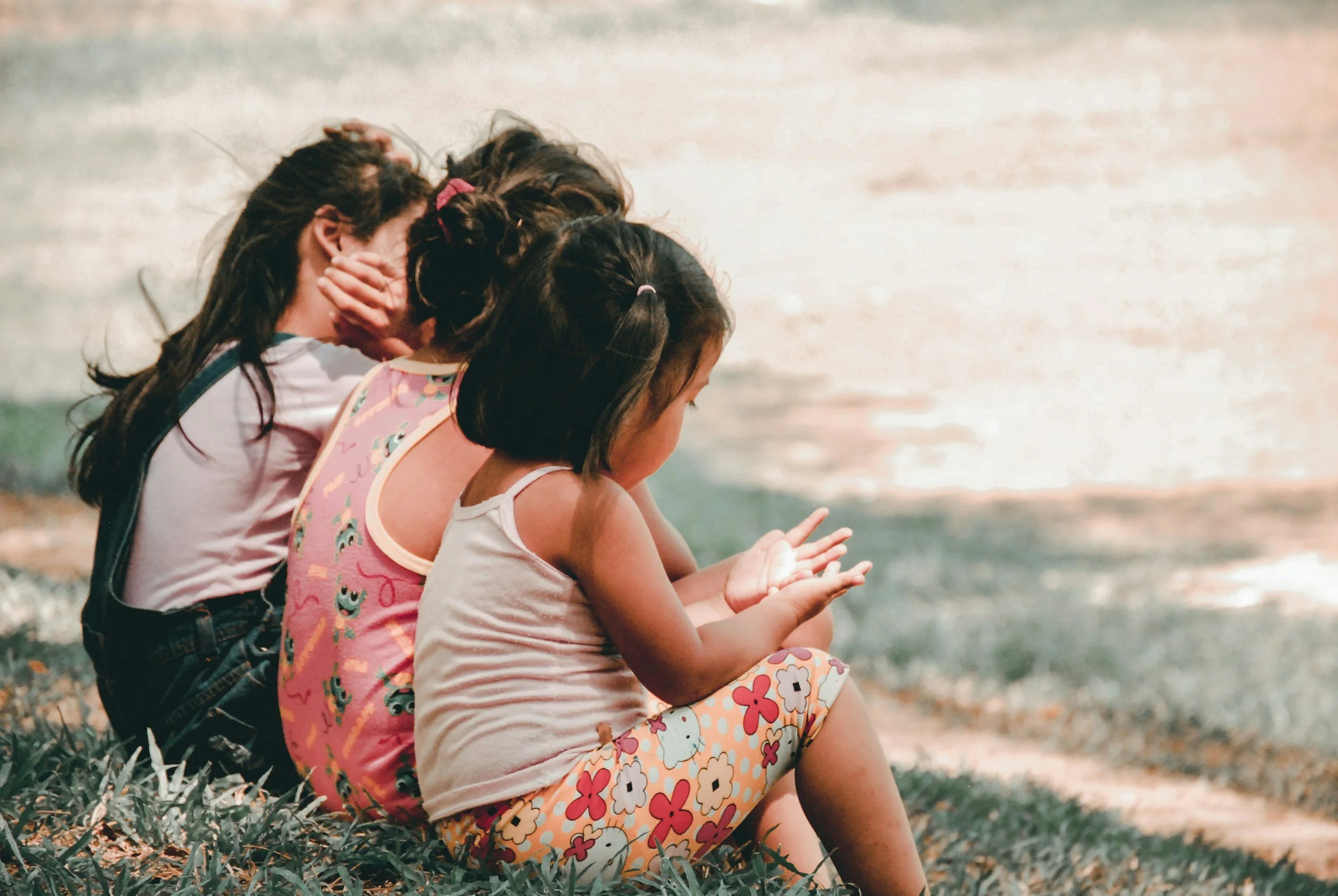
Three girls sitting next to each other on the grass.
Greater Ability to Blend
Another thing of note is that girls seem to have a greater ability to mask their difficulties. They may have more cognitive resources, or feel more of a need to mask and conform to the group (Autistic Girls at School, n.d.). Autistic girls have expressed that they observe and imitate behaviors of peers (Goh, n.d.). This can often mean that, to the untrained eye, they do not need support which we know is not true (Goh, n.d.).
Internalizing Problems
This masking is not without consequence. For autistic girls, interaction can be mentally draining. Interaction involves processing many different things at once which takes up energy (Autistic Girls at School, n.d.). An autistic adolescent girl expressed how she always had to be careful of what she was saying because she may slip up in conversation (Tierney et al., 2016). This constant masking and ignoring of internal states can cause emotional exhaustion (Tierney et al., 2016). It has been linked to increased rates of depression and anxiety in autistic girls (Hull et al., 2020).
Why the Differences?
Children tend to interact in same-gender peer groups (Dean et al., 2017). Boy peer groups tend to be more activity based like sports games (Dean et al., 2017). Girl groups are instead more based on social communication and connection (Dean et al., 2017). This means that social communication difficulties may be more noticeable among girl groups (Dean et al., 2017).
What Can We Do?

Group of children playing with a rainbow parachute
We want autistic girls to tune into their feelings to be able to advocate for their needs. As such, the first step is to strengthen the sense of interoception. Girls need to be able to identify what they feel in their body (interoception) and the associated emotion to know what they need. We also want to help develop a variety of strategies to respond to their emotions. Once they are able to tune into their emotions, they need to be able to advocate for their needs. This means we would want to help them identify their preferences when it comes to communication, environments, etc. Then they need to feel empowered to communicate these needs. This can look like telling a peer that they would prefer to play a different game instead of neglecting their preferences to appease others. The ability to advocate is not easy! We would want to practice this several times to increase confidence in using these skills.
At Larchwood, we are working to develop a program suited to the needs of autistic girls. Join this email list to stay informed of updates relating to our new group coming Fall 2025.
References:
Attwood & Garnett Events. (2018, November 22). Social camouflaging in girls on the autism spectrum: a peer-reviewed study by Lizaan Schwartz, Provisional Psychologist. AttwoodandGarnettevents. https://www.attwoodandgarnettevents.com/blogs/news/social-camouflaging-in-girls-on-the-autism-spectrum-a-peer-reviewed-study-by-lizaan-schwartz-provisional-psychologist
Autistic Girls at School. (n.d.). Common Challenges at School: Peer Relationships. Autistigirlsatschool. https://autisticgirlsatschool.com.au/CommonChallenges/PeerRelationships
Dean, M., Harwood, R. & Kasari, C. (2017). The art of camouflage: Gender differences in the social behaviors of girls and boys with autism-spectrum disorder. Autism, 21(6), 678–689.
Goh, S. (n.d.). The Girl Gap: How Autism Manifests Differently in Girls. CorticaCare. https://www.corticacare.com/care-notes/autism-in-girls
Hull, L., Petrides, K. V., & Mandy, W. (2020). The Female Autism Phenotype and Camouflaging: a Narrative Review. Review Journal of Autism and Developmental Disorders, 7, 306-317.
Tierney, S., Burns, J., & Kilbey, E. (2016). Looking behind the mask: Social coping strategies of girls on the autistic spectrum. Research in Autism Spectrum Disorders, 23, 73-83. https://doi.org/10.1016/j.rasd.2015.11.013